Choosing a course
Before You Pay for an AI Marketing Course, Ask These 7 Questions
Kailas Nath R and Kautilya Roshan
· 6 min read
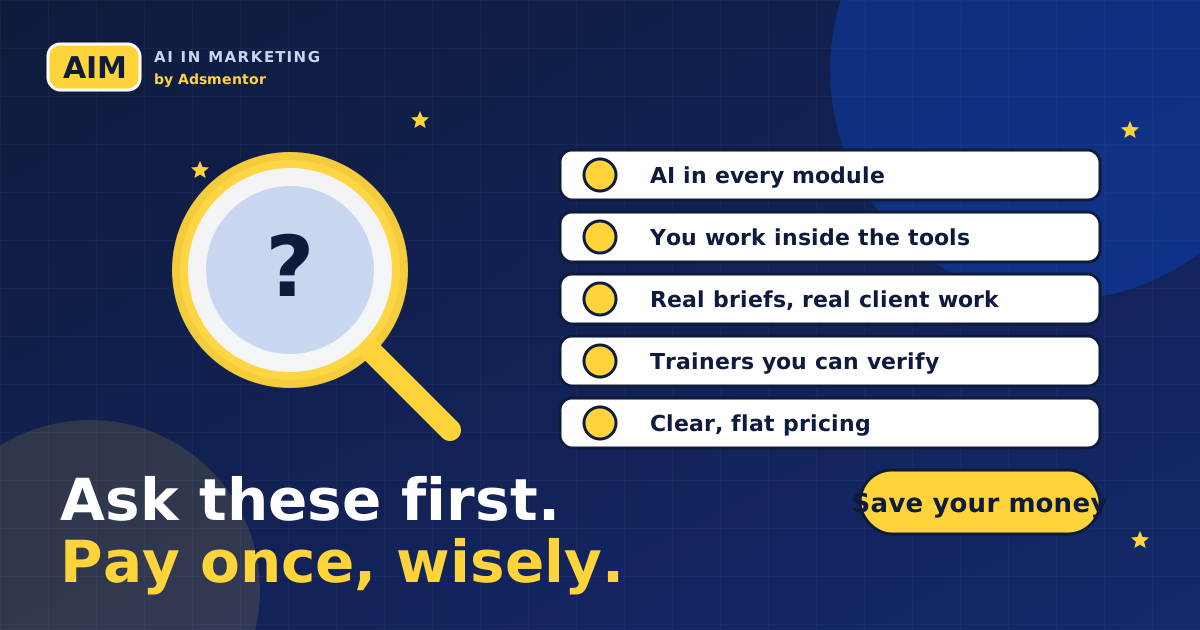
For most families, a course fee is money earned the hard way. Before you spend it, spend ten minutes on these seven questions. They protect your savings and make sure your time turns into skills a company will pay for.
- Ask where AI appears in the syllabus. One chapter at the end is not an AI marketing course.
- Check how many learners share each tool login, and for how long.
- Look for real projects, an internship and trainers you can verify on LinkedIn.
- Ask for the total price, including tools, certificate and GST, before you pay.
Nearly every digital marketing course now says it teaches AI. Most of them mean one module near the end. Here is how to tell the difference.
1. Is AI one chapter, or part of everything you learn?
Companies use AI in ads, content, SEO, conversion and lead handling. If AI is a single module, you will graduate with a topic. If it runs through every module, you will graduate with a way of working. Why it matters to you: the second one is what gets you noticed on day one of a job.
2. Will you work inside the tools, or watch a screen?
In many courses a trainer shares their screen and you imagine you have access. Ask: will I log in and do the tasks myself from the first weeks? Why it matters: skills you practise stick. Skills you watch fade by the weekend.
3. Do you get pro tools, or only free demos?
Ask which tools you will use and whether you get proper access. Why it matters: free tiers often hide the features real jobs depend on, so you learn a smaller version of the work.
4. Are the projects real?
Made-up brands teach you to finish assignments. Briefs shaped like real company needs, and ideally an internship on client work, teach you to do the job. Why it matters: your first interview goes much better when you have already done something similar.
5. Can you check the trainers and the placements?
Trainers should have public profiles with real clients and recommendations. Placements should link to public profiles too. Why it matters: if you cannot verify it, you are paying for a promise.
6. Is the price clear, and is it fair?
Public listings for live digital marketing programs in India ranged from about ₹25,000 to ₹1.64 lakh in October 2026. A higher price does not mean more hands-on practice. Ask what is included, what costs extra and whether tool access is part of the fee.
7. Will you leave with proof, not just paper?
A certificate says you attended. A live portfolio shows what you built. Why it matters: interviewers open portfolios.
How AIM answers these
AI is part of all 9 modules. You work inside the platforms. You finish with a 1-month agency internship and a certificate from that agency. It is a flat ₹5,999 that includes the agency internship, pro tools in month 2 and ad spend for your portfolio. See the fee, the curriculum and the trainers, then compare with anything else on your list.
A simple scorecard you can use with any institute
When you speak to three or four institutes, details blur together. Write the seven questions in a notebook and score each answer from 0 to 2: 0 for vague, 1 for a good answer without proof, 2 for a good answer with proof you can see. A score of 11 or more out of 14 is a strong sign. Below 8 deserves caution.
Red flags that cost people money
- "Lifetime access to tools." Ask which tools, which plans and whether the access is shared. Pro tools are expensive, and unlimited access for a small fee is rarely what it sounds like.
- "100% placement guarantee." No one controls hiring. Look for what they actually do: interview preparation, portfolio review, introductions and links to people who got hired.
- Pressure to pay today. A good program lets you ask questions and think. If a discount disappears in an hour, walk away.
- Trainers without profiles. If you cannot find where the trainers have worked, you cannot judge what they know.
- Syllabus that never mentions a tool name. Real work happens in platforms. A syllabus with no platform names is mostly theory.
What a good first call sounds like
A good counsellor asks about you first: your background, your goal and your budget. They tell you honestly if the program fits, share the full syllabus and fee in writing and let you speak to a past student. Pay only after you are comfortable. If a first call feels like a sales script, that is how the next six months may feel as well.
How to compare a ₹5,999 program with a ₹1,50,000 program
Price is not a quality score in either direction. A higher fee is fair if it pays for things you will use: live teaching, tools, real client work, a strong network. A lower fee is fair if the program is honest about what it includes. Compare using these lines side by side: hours of live teaching, tools included, projects you will build, internship and who will review your work. Then ask yourself, in rupees per useful hour, which one is better value for your situation.
Questions to ask past students
- What did you build, and can I see it?
- How long did it take before you used the skills at work?
- What was missing from the program?
- Would you pay the same fee again?
Why we published our own answers
We would rather you check us against the same seven questions. AI sits inside all nine modules, learners practise inside real tools and the program ends with a one-month agency internship. Our trainers have public LinkedIn profiles, and the fee is a single flat ₹5,999 that you pay after your onboarding call. If another program answers these better, choose it. The goal is that you spend your money well.
Take the checklist to every call
Our free 5-question checklist fits on one page. Use it with us and with any other institute you are considering.
Part of the program: How AIM answers these. The full path is a flat ₹5,999, paid only after your onboarding call. See what is included.
The 5-question course checklist
Ask any institute these five questions before you pay. Takes two minutes and can save you lakhs.
Frequently asked questions
What should an AI marketing course include?
AI in every module, practice inside real tools, real projects, a verifiable trainer team, an internship or client work, and a clear total price.
Is a certificate enough to get a job?
A certificate helps, but employers hire for proof of work. A live portfolio and real project experience matter more.
How many hours of live teaching should I expect?
Ask for the number in writing. Programs differ a lot, and recorded videos should not be counted as live teaching.
Should I pay in full upfront?
Only after you have seen the syllabus, spoken to the team and understood the refund or exit terms.
About the authors

Digital marketing and agentic AI consultant at Big Stone Agency and trainer in the AIM program. Co-author of The Ad Account Nobody Shows You.

Generative AI engineer, LinkedIn Top Voice, consultant and trainer. Co-author of The Ad Account Nobody Shows You.
More from the blog
- Duolingo's AI-First Memo, 18 Months On: What Its Own Filings Show
- A Prompt Framework for Marketers: RTCROS, With Examples You Can Copy
- Meta Ads MCP and CLI: A Step-by-Step Usage SOP for Marketers
- Best Digital Marketing Course in India (2026): AI and Vibe Marketing Compared
- The ₹2.4 Lakh Mistake: Who Really Owns Your Ad Account?
- The Ad Account Nobody Shows You: Social Ads Zero to Pro (2026 Edition)
- What Is Vibe Marketing? Get a Week of Work Done in an Afternoon
- Your Ad Account Runs Itself Now. Here Is How to Stay the One Who Matters
- Fewer Clicks, Same Customers: Stay Visible in the Age of AI Answers
- Agentic AI Can Give You Your Evenings Back (If You Learn It First)
- 6 AI Advertising Mistakes That Can Cost You a Client (and the Easy Fixes)