Prompt guide
A Prompt Framework for Marketers: RTCROS, With Examples You Can Copy
Kailas Nath R and Kautilya Roshan
· 12 min read
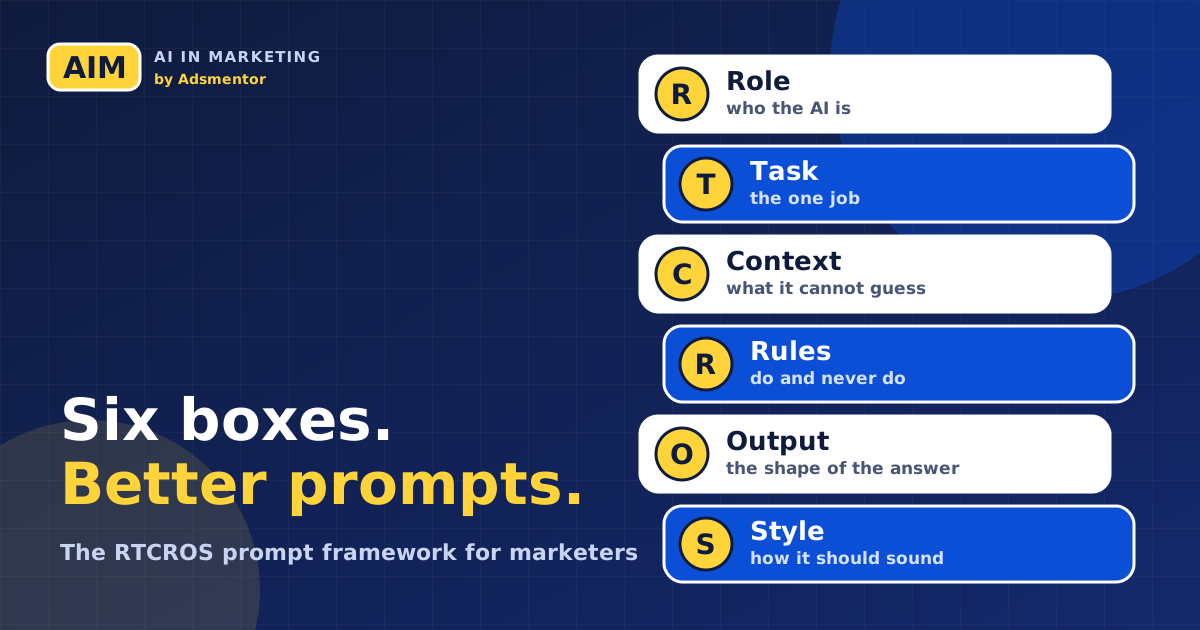
Most marketers do not get poor results from AI because the tool is weak. They get them because the prompt reads like a text to a friend: "write an ad for my class". This guide gives you a six-part prompt framework for marketers, RTCROS, with copy-ready examples for ads, SEO, WhatsApp follow-ups and weekly reports.
- RTCROS stands for Role, Task, Context, Rules, Output format and Style. It is a checklist you run before you press enter, not a magic formula.
- RTCROS is our own working checklist, not an industry standard. Other frameworks, such as CO-STAR from GovTech Singapore, cover similar ground, and the guide shows how they map to each other.
- Anthropic's own prompting guide gives a simple test: show your prompt to a colleague with no background and see if they would be confused. If they would be, the AI will be too.
- Four ready prompts are included for Meta ad review, an SEO brief, a WhatsApp follow-up and a weekly numbers read, each with the six parts labelled.
- A free 3-page PDF with the template, the examples and a checklist is below, branded for AIM by Adsmentor.
Why most prompts disappoint
Picture a new intern on day one. You say, "Write an ad for my yoga class." They would have questions: for whom, where will it run, what is the offer, what is the budget, what can we not say? An AI tool cannot ask those questions unless you invite it to, so it guesses, and guesses sound generic.
Anthropic, the company behind Claude, describes a useful check in its prompting best practices. Its "key test" is to show your prompt to a colleague with minimal context on the task and ask them to follow it. In the guide's words, if they would be confused, Claude will be too. That one test explains most weak AI output in marketing.
A framework turns the test into a habit. You do not need to memorise theory. You need six boxes you fill in every time.
RTCROS in one minute
RTCROS is the checklist we teach at AIM. To be clear about its status: it is not a published standard, and it is not tied to one tool. You will meet other acronyms with similar letters online, and the order of the letters matters far less than covering the six jobs.
| Letter | Question it answers | Weak version | Stronger version |
|---|---|---|---|
| Role | Who should the AI act as? | (nothing) | "You are a senior performance marketer who coaches beginners." |
| Task | What exactly is the job? | "Help with my ad" | "Review the Meta ad below and find its three weakest points." |
| Context | What does it need to know that it cannot guess? | (nothing) | "Weekend yoga workshop, Pune, working women 28 to 40, goal 50 sign-ups." |
| Rules | What must it do, and never do? | (nothing) | "Do not invent statistics. Flag any claim that could break ad policy." |
| Output format | What shape should the answer take? | "Give me ideas" | "A table: issue, why it matters, one fix." |
| Style | How should it sound? | (nothing) | "Plain English, warm, under 150 words, no jargon." |
Read down the "weak" column and you will see most of the prompts you have written so far. The good news is that the fix costs about two minutes.
The six parts, one by one
Role: point the AI at the right kind of thinking
A role is a short sentence that focuses the answer. Anthropic's guide says setting a role in the system prompt focuses the model's behaviour and tone, and that even a single sentence makes a difference. For marketers, think of the person you would hire for the job: a copywriter for Indian D2C brands, an SEO editor, a CRM specialist. Name the helper and, if it matters, who the answer is for: "explain to a shop owner with no marketing background".
Task: one verb, one deliverable
Good tasks start with a verb and name the thing you will receive: "Rewrite", "Review", "List", "Compare", "Draft three versions". If you want two jobs done, make two prompts or number the steps. A prompt that asks for strategy, copy and a report in one go gets a little of each and not enough of any.
Context: the facts it cannot guess
Context is where your knowledge enters. Include the business, the audience, the goal, the numbers you already have, the offer, the channel and what you tried before. Paste real text, for example last month's best ad, instead of describing it. Leave out private data you should not share, such as customer phone numbers.
Rules: fences, not decoration
Rules are the do and do-not list. Useful rules for marketers include: use only the facts I gave you, do not invent numbers or testimonials, keep claims inside advertising policy, avoid words I have banned, ask me a question if something is missing. A rule that says "ask me before guessing" prevents many confident mistakes.
Output format: decide the shape before you read it
Ask for the format you will actually use: a table you can paste into a sheet, five options numbered, a headline under 40 characters, a checklist. If the output will go into another tool, say so. Anthropic's guide also suggests using XML-style tags such as <context> and <input> when a prompt mixes instructions with pasted material, because wrapping each type of content in its own tag reduces misinterpretation.
Style: voice and reading level
Style is the sound of the answer: warm or formal, plain English or Hinglish, short sentences, no jargon, the brand's voice. Pasting two or three samples of your brand's writing and saying "match this voice" is more reliable than adjectives alone. The same guide notes that a few well-crafted examples, known as few-shot or multishot prompting, improve accuracy and consistency.
One prompt, built step by step
Here is the idea in action. The scenario is an example brief we made up for teaching, not a real client: a weekend yoga workshop in Pune for working women.
Version 1: "Write a Facebook ad for my yoga workshop."
The result is predictable: "Unlock your inner peace!" Now add the six parts.
Role: You are a senior performance copywriter who writes Meta ads for Indian small businesses.
Task: Write three versions of primary text for a Facebook and Instagram feed ad.
Context: A two-day weekend yoga workshop in Pune, fee ₹499, for working women aged 28 to 40 who feel stiff after desk jobs. Goal: 50 sign-ups in ten days. Trainer has taught for 8 years.
Rules: Use only the facts above. Do not promise medical results. Do not use the words "miracle" or "cure". If a fact is missing, ask me before guessing.
Output format: Three versions, each with a headline under 40 characters and primary text under 125 characters, in a table.
Style: Warm, plain English, speak to one woman, no jargon.
The second prompt is longer, but you will spend less time editing, and the answer will contain things you can check against your facts. Notice the rule "if a fact is missing, ask me". It turns the AI from a guesser into a collaborator.
Four copy-ready prompts for everyday marketing work
Swap the details in brackets for your own. Each one carries all six parts. Read the answers critically: the framework improves the first draft, it does not replace your judgement.
1. Review a Meta ad before it goes live
Role: You are a paid social reviewer who checks ads the way a strict client would.
Task: Review the ad copy below and list the three weakest points.
Context: [Business, audience, offer, goal, budget]. The ad copy is inside the tags: <ad>paste copy here</ad>.
Rules: Do not rewrite the ad. Ask me one question per weak point. Flag any claim that could break Meta ad policy.
Output format: A table with three columns: weak point, why it matters, question for me.
Style: Direct and kind, under 150 words.
2. Draft an SEO content brief
Role: You are an SEO editor who writes briefs for freelance writers.
Task: Create a content brief for a blog post targeting the phrase [keyword].
Context: The reader is [who], the site sells [what], and the post should lead to [action]. Our three closest competitors' headings are inside <competitors>paste headings here</competitors>.
Rules: Do not invent statistics or studies. Suggest sections that answer real questions, not stuffing. Mark anything that needs a source.
Output format: Working title, search intent in one line, an outline with H2 headings, five FAQs, a list of facts that need a source.
Style: Plain English a junior writer can follow.
3. Write a WhatsApp follow-up for new leads
Role: You are a friendly CRM specialist for a small business.
Task: Draft a three-message WhatsApp follow-up for someone who enquired and has not replied.
Context: [Product or service], enquiry came from [source], typical question is [question]. Messages go out on day 1, day 3 and day 7.
Rules: No pressure language. Do not mention discounts I have not approved. Each message must give one useful fact and one easy next step.
Output format: Three numbered messages, each under 50 words.
Style: Warm and conversational, English with simple Hindi words only if I ask.
4. Read your weekly numbers
Role: You are a marketing analyst who explains numbers to non-experts.
Task: Read the table below and tell me what changed this week and what to check first.
Context: Goal is [goal]. Spend, clicks and leads for this week and last week are inside <data>paste table here</data>.
Rules: Use only the numbers provided. Separate what the data shows from what you are guessing. Suggest checks, not conclusions.
Output format: Three bullets for what changed, then a "check first" list of three items.
Style: Short sentences, no jargon.
For a deeper example of RTCROS applied to a high-stakes setting, see our Meta Ads MCP and CLI usage SOP, where the Rules section is what keeps an AI agent from spending money without approval.
Other prompt structures worth knowing
RTCROS is one of several ways to organise a prompt. Knowing a second one helps you see what each leaves out.
CO-STAR. GovTech Singapore's guidance, described on the tech.gov.sg site (3 April 2025), lists six components: Context, Objective, Style, Tone, Audience and Response. GovTech says its officers follow the framework in its Prompt Engineering Playbook. Here is how the two map:
| RTCROS | CO-STAR | Difference worth noticing |
|---|---|---|
| Role | (not a separate part) | RTCROS names who the AI is. |
| Task | Objective | Same job: say what you want. |
| Context | Context | Same job: background the AI cannot guess. |
| Rules | (not a separate part) | RTCROS adds do and do-not fences. |
| Output format | Response | Same job: define the shape of the answer. |
| Style | Style and Tone | CO-STAR splits voice into two. |
| (not a separate part) | Audience | In RTCROS, put the audience inside Context or Role. |
If you write for different readers all day, borrow CO-STAR's Audience line and add it to your Context. If you run an agent that can take actions, keep RTCROS's Rules.
Examples, tags and steps. Three techniques from Anthropic's guide work with any framework. Give a few examples of the voice or format you want. Wrap pasted material in tags so the AI can tell your instructions from your data. And split a big job into stages, where the output of one prompt becomes the input of the next. Anthropic's prompt engineering overview lists "clarity and examples", "XML structuring", "role prompting", "thinking" and "prompt chaining" among its techniques.
Our view: pick one framework, use it for two weeks and keep a note of which prompts worked. A framework you use beats a better one you forget.
Common mistakes and quick fixes
- Pasting too little context. Fix: paste the real offer, the real audience and one example of work you like.
- Asking for everything at once. Fix: break it into steps and approve each one.
- No rules. Fix: add "use only the facts above" and "ask me if something is missing".
- Accepting the first answer. Fix: ask "what is the weakest part of this answer?" and fix it.
- Believing confident numbers. Fix: ask for the source or say "mark anything you cannot support". Check facts before anything is published.
- Sharing private data. Fix: remove names, phone numbers and client details first. Our post on AI advertising mistakes covers data slips and unchecked claims in more detail.
What to do this week
- Pick one task you repeat weekly, such as ad review or a report summary.
- Write it as an RTCROS prompt and save it in a notes app or sheet.
- Run it on a real example and mark what you had to fix by hand.
- Turn each fix into a Rule or a Context line, then run it again.
- After a week you will have one reliable prompt. After a month you will have a library. That is the habit behind vibe marketing, and the first step before you hand repeat work to an AI agent.
If you are a fresher, keep your best three prompts and their before-and-after outputs in a simple portfolio page. It shows an interviewer how you think, which a certificate cannot.
How we teach prompting at AIM
In AIM we do not teach prompts as tricks to memorise. Learners use the same checklist on real tasks across the modules: SEO briefs, social content, automations and ad analysis, and trainers review the work and point out weak prompts. We have not tested RTCROS in a controlled study, so we describe it as a practical habit that works for us, not as a proven method. If you are comparing courses, our guide to questions to ask before paying for an AI marketing course is a good starting list.
Get the RTCROS prompt guide as a PDF
Three pages you can keep next to your laptop: the RTCROS template, four marketing prompts with every part labelled, a CO-STAR comparison and a ten-point prompt check.
Free PDF, no spam. See how we handle your details in the privacy policy.
RTCROS prompt guide for marketers
Template, four worked marketing prompts and a pre-send checklist, branded for AIM by Adsmentor.
Frequently asked questions
What is RTCROS in prompt writing?
RTCROS is a six-part checklist for writing prompts: Role, Task, Context, Rules, Output format and Style. It is a practical habit we teach at AIM, not an official industry standard.
Is RTCROS better than CO-STAR?
Neither is proven better. CO-STAR, described by GovTech Singapore, adds an Audience part and splits style and tone. RTCROS adds a Role and a Rules part. Pick one, use it for two weeks and keep what works.
Can I use RTCROS with ChatGPT, Claude and Gemini?
Yes. The six parts are plain language, so they work in any chat-based AI tool. Test each tool with the same prompt because outputs differ.
How long should a prompt be?
As long as it needs to pass the colleague test: would someone with no background understand the job? For most marketing tasks that is six short lines, plus any pasted material.
Do I need to know coding to write good prompts?
No. You need clear thinking about the task, the audience and the rules. Basic marketing knowledge helps you judge whether the answer is good.
Sources and how we checked them
Every source below was opened for this guide. Where a figure or quotation is used, it is attributed in the text.
- Prompting best practices, Anthropic documentation, read 3 November 2026. Used for the colleague test, role, examples and XML tag guidance.
- Prompt engineering overview, Anthropic documentation, read 3 November 2026. Used for the list of techniques.
- Mastering the art of prompt engineering with Empower, GovTech Singapore, 3 April 2025. Used for the six CO-STAR components.
How we checked this. The RTCROS framework itself is our own teaching checklist, so no outside source supports it as a standard. We searched for it by name and found only promotional pages that use a similar acronym with different letters, so we make no claim about its origin. The four marketing prompts are examples we wrote; the yoga workshop is a made-up brief for teaching. Tools change quickly, so test every prompt on your own account and data.
About the authors

Digital marketing and agentic AI consultant at Big Stone Agency and trainer in the AIM program. Co-author of The Ad Account Nobody Shows You.

Generative AI engineer, LinkedIn Top Voice, consultant and trainer. Co-author of The Ad Account Nobody Shows You.
More from the blog
- Duolingo's AI-First Memo, 18 Months On: What Its Own Filings Show
- Meta Ads MCP and CLI: A Step-by-Step Usage SOP for Marketers
- Best Digital Marketing Course in India (2026): AI and Vibe Marketing Compared
- The ₹2.4 Lakh Mistake: Who Really Owns Your Ad Account?
- The Ad Account Nobody Shows You: Social Ads Zero to Pro (2026 Edition)
- What Is Vibe Marketing? Get a Week of Work Done in an Afternoon
- Before You Pay for an AI Marketing Course, Ask These 7 Questions
- Your Ad Account Runs Itself Now. Here Is How to Stay the One Who Matters
- Fewer Clicks, Same Customers: Stay Visible in the Age of AI Answers
- Agentic AI Can Give You Your Evenings Back (If You Learn It First)
- 6 AI Advertising Mistakes That Can Cost You a Client (and the Easy Fixes)